
One Piece Chapter 1191: Imu’s Demonic Form and the Union of Loki and Hajrudin

Warning: this article contains details about chapter 1191 of One Piece.
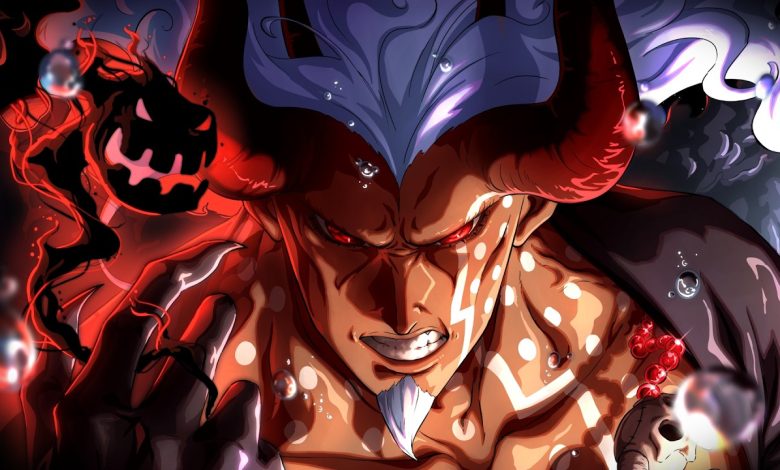
Chapter 1191 places Elbaf before a threat that goes far beyond the scope of an ordinary confrontation. Imu Nerona rises from the underworld and unveils a new transformation, while Scopper Gaban provides alarming details about the nature of this enemy. Facing him, Luffy regains his energy, and the two giant princes, Loki and Hajrudin, finally begin to act like brothers.
Between a demonic appearance, occult symbols, the mystery of Devil Fruits, and family reconciliation, this chapter brings together several major themes of the Elbaf arc.
Imu unveils a form that reinforces his demonic image
After falling into Elbaf’s underworld, Imu reappears in the Sun World in a different form. This transformation catches the fighters off guard: while expectations may have centered on a new evolution for Luffy, it is the ruler of the world who abruptly changes appearance.
Scopper Gaban then offers a particularly powerful definition when he is asked about the enemy’s identity: if he had to describe him, he would call him a “god.” The wording is troubling in a world where supposed gods are repeatedly brought back to their human condition. The Celestial Dragons consider themselves divinities, yet they are only men; Enel himself was a self-proclaimed god.
However, the word chosen by Gaban may point toward another possibility. Whitebeard once mentioned the land of the gods, located above the Red Line before the World Government was created. That territory was associated with the Lunarians, a people whose physical features recall several elements connected to Imu: unusual traits, black wings, and fire imagery. Under this reading, Imu could be seen as a being from an ancient world, or even as a Lunarian in the eyes of those who know the secrets of the Void Century.
Gaban also states that Imu is immortal and impossible to defeat through ordinary means. This resilience raises questions about the link between the ruler of the world and his servants. Sommers, Gillingham, and Gunko may receive a portion of his power, through a mechanism reminiscent of a fragmented and shared power.
Baphomet, horns, and symbols of transformation
Imu’s new silhouette strongly evokes Baphomet, a figure popularized in the 19th century by Éliphas Lévi in his illustration known as The Baphomet of Mendes. This depiction combines a goat’s head, horns, dark wings, androgynous attributes, and references to alchemy.
Several visible elements in Imu make a visual parallel possible: an already ambiguous appearance, loose clothing, large horns, claws, and an increasingly monstrous presence. If fully confirmed, the black wings would further strengthen the connection to the Lunarian and demonic imagery surrounding the character.
Two words written on Lévi’s Baphomet’s arms also deserve attention: solve and coagula. They refer to an alchemical principle of dissolving a form in order to recompose it differently. This idea ties into a central theory about Imu: his power could be connected to the transformation of nature itself, especially through Devil Fruits.
Imu’s forearms are now wrapped in his hagoromo. In a symbolic interpretation, this detail could replace the alchemical formulas associated with Baphomet: where the occult image evokes dissolution and recomposition, Imu would carry on his own body the power that allows him to transform the world.
Is Imu the origin of Devil Fruits?
The chapter fuels an ambitious hypothesis: Imu may not simply be a Devil Fruit user, but may possess a “special power: Devil Fruits.” This wording differs from the usual presentation of power holders in the manga, who are generally associated with a specific fruit.
Vegapunk explained in chapter 1069 that Devil Fruits may represent evolutionary possibilities desired by people. Each one would embody a wish: becoming capable of doing something impossible, surpassing the limits imposed by the body or nature. Yet these powers are also described as being contrary to nature.
One possible reading therefore involves an outside intervention in this process. The Eve Tree, whose existence is linked to the Red Line and Fish-Man Island, may have been diverted from its natural purpose in order to produce these fruits. Imu may then have corrupted a living tree to turn it into a source of powers.
This theory gives a different meaning to the term “Devil Fruits.” Drawn to power, people may have accepted a kind of pact: receiving an extraordinary ability in exchange for breaking with the natural order. The Hâley inscriptions, which speak of people giving in to their desires and touching a forbidden sun, fit with this idea of temptation, forced progress, and the Earth’s anger.
Imu could therefore be the devil not because he ate a fruit, but because he may be the origin of the system that makes them possible. His increasingly beastly form would then be only a visual manifestation of that role.
Does Adam’s mural foreshadow Imu’s final form?
The mural revealed in chapter 1138 is taking on increasing importance. It depicts a gigantic, horned, dark silhouette, several of whose traits appear to be reflected in Imu’s current transformation. The horns, claws, wings, and overall shadowy shape of the monster form a close enough match to consider it a foreshadowing of his ultimate form.
Its size would be the most spectacular element. In the mural, even Loki appears tiny beside the creature. Imu could therefore continue to grow throughout the battle, eventually becoming a colossal opponent. A power such as the Mother Flame may also contribute to this escalation, although this has not yet been confirmed.
Against this threat, Luffy may be forced to use Gear 5 on a gigantic scale. The idea of a duel between a white, solar Nika armed with materialized objects and a demonic Imu wielding royal weapons would create a powerful visual opposition: liberation against domination.
Later developments in the confrontation, particularly in chapter 1192 and Luffy’s Star Gun against Imu, already extend the importance of this clash on Elbaf.
Luffy regains his strength, but the question of his injuries remains
Luffy recovers once again through food. The process is not unprecedented: the hero has often recovered after eating, whether after his defeat against Kaido or during the events of Egghead. His excessive resilience is a consistent part of the character.
Still, the context makes this recovery harder to accept. Luffy had been seriously injured, notably by two blades embedded in his body. Seeing him state that his wounds are healing after eating inevitably raises the question of the consequences.
It remains possible that this confidence masks an adrenaline effect or a form of denial. Gaban himself stresses that this recovery should not work that way. The next chapter will therefore need to clarify whether Luffy is truly fit to fight or whether he risks collapsing after pushing his body beyond its limits.
This situation also raises questions about Chopper’s role. The Straw Hats’ doctor is nearby, yet he does not directly intervene in treating his captain. Luffy traditionally relies on his companions; seeing him recover on his own through food temporarily diminishes Chopper’s medical role in what is nevertheless a critical scene.
Loki and Hajrudin finally become Elbaf’s two forces
The emotional core of the chapter may lie with the giant princes. Hajrudin displays determination comparable to what he showed against Machvise in Dressrosa. At the time, he was willing to break his own body to defend his honor. Now, he pits his strength against a threat directed at Elbaf.
His action also answers Loki’s: the two brothers, long separated by resentment and by the legacy of their father Harald, come together in the same act of protection. Their rivalry has not disappeared, but it no longer prevents them from cooperating.
Harald’s dream was to make Elbaf a country capable of favoring trade and peace without abandoning the strength of its warriors. His mistake may have been trying to carry that ambition alone, to the point of continually being absent from his own kingdom. Loki and Hajrudin can succeed where he failed because they embody two complementary sides: one has the strength of a warrior, while the other has the ambition to rule the giants.
Their combined attack with Luffy, Gokoku, follows in the tradition of Hakoku. Since Dorry and Brogy, Elbaf’s warriors have drawn their strength from unity. This time, Loki, Hajrudin, and Luffy concentrate their power to answer Imu’s invasion. Elbaf no longer merely endures: the land of the giants takes the initiative back.
This development connects with the stakes explored later through Zoro’s progress and the Holy Knights in chapter 1193. The battle for Elbaf does not rest on a single hero, but on an alliance of wills capable of challenging Imu’s hold.
One Piece Chapter 1191 FAQ
Did Imu reveal his final form in chapter 1191?
No. Imu unveils a new, more demonic form, but several elements suggest that he could evolve further. The mural from chapter 1138 is notably interpreted as a possible depiction of his ultimate form.
Why does Scopper Gaban describe Imu as a god?
Gaban uses this term to emphasize Imu’s exceptional nature. The description may also be connected to the land of the gods, the Lunarians, and the secrets known by the former members of Roger’s crew.
What is the supposed connection between Imu and Devil Fruits?
One theory suggests that Imu may be able to create Devil Fruits after corrupting the Eve Tree. It is based on the unusual wording of his power, Vegapunk’s statements about evolution against nature, and references to humanity’s desire for power.
Why is the alliance between Loki and Hajrudin important?
The two brothers finally answer Harald’s wish to see them cooperate for Elbaf. Their union allows the country to move beyond its old wounds and face Imu with collective strength.
