

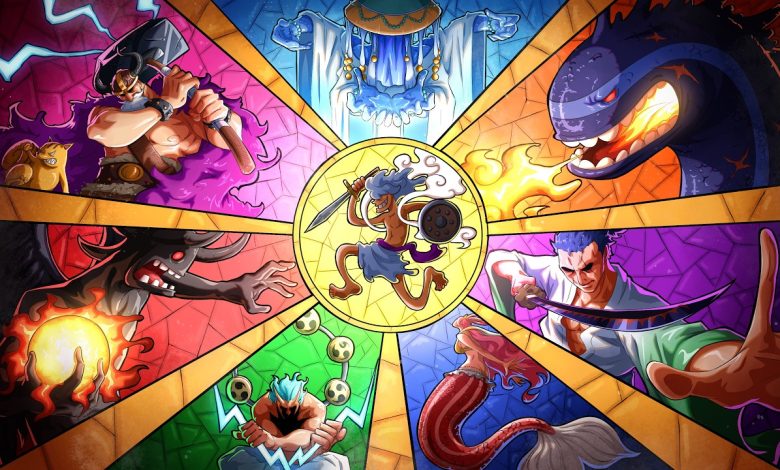
The gods in One Piece do not form a single, clearly established pantheon. The term can refer to a legend passed down by a people, a political title, a creature considered incomprehensible, a hero who became a myth, or a person whose powers seem to transcend the laws of the world.
From Skypiea to Wano, from Jaya to Elbaf, from Fish-Man Island to Mary Geoise, Eiichiro Oda connects the beliefs of his civilizations to their fears, hopes, and history. Nika, the Sun God, is the best-known figure, but he is far from the only “god” mentioned in the story.
Nika, the Sun God and Warrior of Liberation
Nika is called the Sun God, the Warrior of Liberation, and the White Warrior. His name has been revered for centuries by slaves and oppressed people, who see him as a liberator who may appear when the world is about to undergo a great upheaval.
The stories associated with Nika describe a fighter with a rubber body, able to battle with a freedom and imagination that seem to bend reality itself. Among the giants of Elbaf, he is also known for having fought the God of War. Yet belief in him is not limited to one territory: the Shandians worship him as well, while the Buccaneers have passed down his cult.
Dr. Vegapunk establishes a direct connection between this figure and Monkey D. Luffy after the awakening of the Hito Hito no Mi, Model: Nika. Luffy’s power therefore explains why some characters call him Nika, while others recognize Joy Boy in him. The two figures share several traits: a white appearance, a rubber body, and a laugh that frees others from their suffering.
This closeness leaves an essential ambiguity unresolved: are Nika, Joy Boy, and Luffy three separate individuals, or several incarnations and names of the same will? The story has not settled the question definitively. One certainty remains: to the World Government, Nika is a major threat because he embodies what every authoritarian power fears—freedom.
The question takes on particular importance in the recent clashes between Luffy and the ruler of the world, especially as the connection between Joy Boy, Imu, and the One Piece becomes central.
The God of War: Elbaf’s Legend and Loki
Elbaf’s legends speak of a God of War, a gigantic warrior whose mere presence heralded the end of the world. Giant society has long been built around a sacred vision of battle: courage in the face of death determines a warrior’s worth, and veterans are deeply respected.
This deity is said to have wielded Ragnir, a colossal hammer, alongside Ratatosque, a legendary ice squirrel. His power came from the Ryu Ryu no Mi, Model: Nidhogg, a Mythical Zoan Devil Fruit that allowed him to become an enormous black dragon. Together with Ratatosque, he could summon lightning and ice.
After a final confrontation with the Sun God, the God of War is said to have fallen asleep. Ragnir then protected the Nidhogg Fruit for centuries, until Loki ate it. Elbaf’s cursed prince thus becomes the modern incarnation of this warrior figure: an ancient giant linked to the hammer Ragnir, the dragon Nidhogg, and Ratatosque.
Ryuma, Wano’s God of the Blade
Ryuma Shimotsuki is the God of the Blade, but his case shows that a human can achieve divine status through the sheer power of legend. This one-eyed samurai lived when Wano was still called the Land of Gold. His swordsmanship was so extraordinary that it reached beyond the borders of this closed nation.
As Wano’s protector against pirates and criminals who came to plunder its resources, Ryuma turned his katana Shusui into a permanent black blade by repeatedly imbuing it with Armament Haki. The weapon later became a national treasure.
His most famous feat remains the dragon he slew in a single strike to save the Flower Capital. He died of illness at the age of 47 in the Ringo region, but he never ceased to be a protective figure for Wano. Centuries later, Gecko Moria stole his body and revived it on Thriller Bark with Brook’s shadow.
When facing Roronoa Zoro, Ryuma recognizes a Shimotsuki heir and gives him Shusui. Zoro, in turn, becomes a one-eyed samurai capable of cutting down a dragon. This symbolic lineage supports the idea that he could embody the successor to the God of the Blade, a theme tied to his growth around Conqueror’s Haki, explored in Zoro’s conscious awakening of Conqueror’s Haki.
The Four Shandian Gods: Sun, Rain, Forest, and Earth
Shandian tradition mentions four deities: the God of the Sun, the God of Rain, the God of the Forest, and the God of the Earth. Their presence in the beliefs of Jaya, as well as in texts connected to Elbaf, suggests that they are fundamental figures in the world of One Piece.
Zaza, the God of Rain
Zaza is associated with pouring rain, and his name echoes an onomatopoeia for falling water. He appears through the rain dance, just as the Sun God manifests to the rhythm of drums. Above all, this deity embodies a fear: that of storms, water falling from the sky, and what remains beyond the control of Mary Geoise’s inhabitants.
On Elbaf, Saint Rimoshifu Killingham’s power materializes Zaza from his own fear. The source does not make it possible to identify his exact ability. The idea of a Zaza-related Zoan Devil Fruit therefore remains a hypothesis, as do theories involving Monkey D. Dragon, Nami, or Vivi, who are often associated with rain.
The God of the Forest
The God of the Forest is presented as a threat in Elbaf’s texts: during the second world, he is said to have sent his demons. Yet he is worshipped by the Shandians. This contrast between two peoples highlights a recurring principle: a protective god to some can be a demon to others.
His possible connection to the tree of Devil Fruits is a major lead, but it remains unconfirmed. The origin of these fruits and the will they carry remain among the universe’s greatest mysteries.
The God of the Earth
The God of the Earth is described in Elbaf’s first world. When slaves prayed and the Sun God answered their call, this deity, overcome by rage, is said to have risen alongside the serpent of hellfire. The world was then swallowed by death and darkness.
He appears to be the most threatening of the four Shandian gods and a direct opponent of Nika. If Nika represents hope, the God of the Earth could symbolize human anger. His current incarnation remains unknown.
The Five Elders: Gods Through Political Power
The Five Elders, or Gorosei, bear the titles of Warrior Gods: Saint Shepherd Ju Peter is the Warrior God of Agriculture; Saint Topman Warcury, the Warrior God of Justice; Saint Ethanbaron V. Nusjuro, the Warrior God of Finance; Saint Marcus Mars, the Warrior God of the Environment; and Saint Jaygarcia Saturn was the Warrior God of Scientific Defense before being replaced by Saint Garling Figarland.
Their power, regeneration, terrifying forms, and position at the summit of the World Government feed this divine image. Yet their divinity is primarily institutional: they place themselves above others because they dominate the political system. They remain subordinate to Imu Nerona, an even more absolute authority. Saturn’s downfall above all proves that a “god” can be punished and replaced.
Lunarians and the Gods of Skypiea: When the Divine Depends on Perspective
The Lunarians once lived atop the Red Line, in the Land of Gods, before being exterminated for an unknown reason. With black wings, silver hair, and eternal flames on their backs, they can fly, create fire, withstand physical damage, and adapt to every environment. To ordinary humans, they possessed every characteristic of divine beings.
King, formerly known as Alber, is presented as the only survivor of this lineage. Their history raises a powerful question: what is a god when no one remembers or prays to them anymore?
In Skypiea, the title of Kami simply refers to the island’s ruler. Gan Fall demonstrates how simple it is: he is not omnipotent, merely invested with an office. Enel, meanwhile, was able to pass himself off as a deity thanks to the Goro Goro no Mi and Observation Haki. His mastery of lightning allowed him to listen to an entire island and strike down what seemed like heavenly punishment. Against Luffy’s rubber body, however, he becomes vulnerable again.
Poseidon, the Ancient Weapons, and Other Divine Figures
The Ancient Weapons also bear the names of gods. Poseidon is actually Shirahoshi, a peaceful young girl capable of commanding the Sea Kings. Her power is nevertheless enough to make her a weapon capable of threatening the entire world in the eyes of governments.
Divinity does not necessarily require a Mythical Devil Fruit. Through her navigation, meteorological knowledge, and weapon associated with Zeus, Nami can appear as a goddess to many inhabitants. Gol D. Roger is a god of piracy without a Devil Fruit power. Whitebeard possessed a force that Sengoku associated with the destruction of the world. Kaido, a dragon to the people of Wano, could likewise be perceived as a god.
FAQ: Understanding the Gods in One Piece
How many gods are mentioned in One Piece?
There is no definitive number. The most important figures include Nika, the four Shandian deities, Ryuma, the Gorosei’s Warrior Gods, Skypiea’s Kami, and beings associated with the Ancient Weapons.
Is Nika truly a god?
Nika is a figure worshipped as a god and recognized through Luffy’s awakened Devil Fruit. His historical existence remains surrounded by ambiguity, particularly because of his connection with Joy Boy.
Who is the God of the Earth in One Piece?
The God of the Earth is one of the four Shandian deities. The texts describe him as an angry force associated with the serpent of hellfire, but his identity or current incarnation has not been revealed.
Ultimately, One Piece does not portray gods as immutable truths. They are consequences of human faith: names given to freedom, fear, power, courage, or the unknown. The same character can therefore be a monster, a liberator, or a god depending on the story told by the person looking at them.
