

Warning: this article discusses events from One Piece chapter 1182.
Chapter 1182 brings gods back to the forefront in One Piece, though not necessarily in the sense of a pantheon of higher beings living far away from humanity. The appearance of Zaza, introduced as the rain goddess, mainly extends a long-standing idea in the manga: deities are tied to beliefs, fears, and powers that people cannot explain.
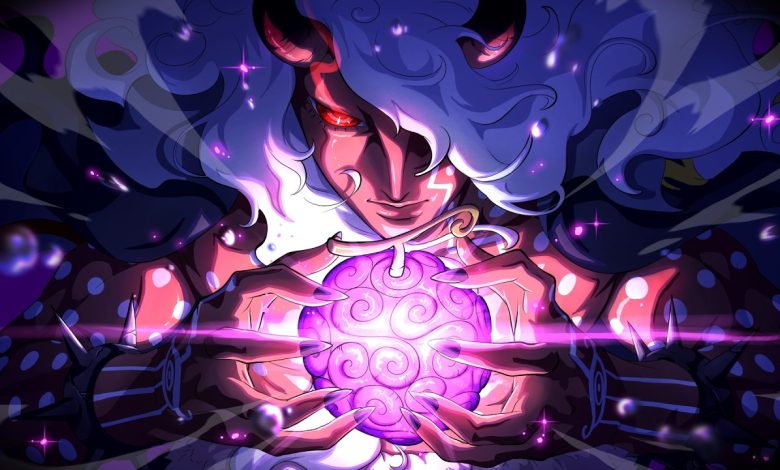
This interpretation becomes especially important when Imu speaks directly to Nika, Niog, and Ratatosque. The ruler of the world seems to recognize these entities with a sense of familiarity, perhaps even nostalgia. That is enough to fuel a staggering possibility: could Imu be connected to the very creation of Devil Fruits?
Zaza, a New Figure in the One Piece Pantheon
The name Zaza refers to driving rain. In chapter 1182, the goddess appears as a materialization of fear, much like the figures summoned by the nightmares connected to Killingham’s power. She should not necessarily be understood as a physical and independent goddess: she may represent the image that the people of Elbaf, and especially the God’s Knights, have of a feared power.
This revelation echoes a much older moment from the Skypiea arc. During Mousse’s sacrifice, the Shandians invoked four deities: the god of the sun, the god of rain, the god of the forest, and the god of the earth. For a long time, those names appeared to belong to local folklore. Since the revelation of Nika, the sun god, however, they have taken on an entirely different significance.
Chapter 1182 therefore makes it possible to connect two of the four Shandian figures to names now known: Nika for the sun and Zaza for the rain. The god of the forest and the god of the earth remain mysterious. Identifying them could become essential if the God’s Knights’ fears truly correspond to these ancient deities.
To explore how the manga handles these religious and legendary figures, our guide to all the gods in One Piece and their powers shows that divinity very often depends on how people perceive it.
Gods May Not Be Beings Separate From Humanity
The idea is not new in the series. In Skypiea, Gan Fall states that gods do not exist in the land of men. Later, Vegapunk provides another key to understanding the matter by describing Devil Fruits as expressions of human desires and the possibilities for evolution imagined by humanity.
Following that logic, a god is not necessarily a celestial creature. It can be a human, a weapon, or a power so extraordinary that it becomes divine in the eyes of those who witness it. Whitebeard was described as a man capable of destroying the world. Crocodile could dry out an entire kingdom. Kaido, in his dragon form, embodied a force beyond all human measure.
Luffy himself perfectly illustrates this mechanism. To his companions, he remains Luffy, their unpredictable captain. To those who discover his Gear 5 and the legend of Nika, he resembles a god from ancient tales. The manga does not deny the power of that symbol; instead, it suggests that this power is born from faith, history, and individual perception.
Zaza seems to follow the same principle. The rain goddess may be less a specific person than a mythical identity that can be embodied by a character or a power connected to the weather.
Vivi, Nami, and Imu: Three Leads Around the Rain Goddess
Vivi and Alabasta’s Rain
Vivi is a natural candidate for the image of Zaza. In Alabasta, her desperate cry comes just before rain returns and gradually brings the civil war to an end. The story later makes it clear that the rain was not caused by Dance Powder, as Smoker himself rules out that possibility.
It remains impossible to state that Vivi caused this event. Nevertheless, the paneling creates a strong connection between the princess’s cry and the calm that comes from the sky. Her Nefertari heritage, her importance in Imu’s plans, and her relationship with Alabasta make her a particularly credible figure in any theory involving a deity associated with rain.
Nami, Master of the Climate
Nami is the other obvious candidate. Since the beginning of the manga, she has possessed an exceptional understanding of the weather. She does not simply apply technical knowledge: she seems to feel atmospheric changes through her body.
Her arsenal further strengthens this connection. With the Clima-Tact and Zeus, Nami can form clouds, summon lightning, and trigger rainfall. Chapters 1176 and 1177 specifically show her creating driving rain in Elbaf before Killingham’s eyes.
Zaza’s four arms may even evoke one of Nami’s techniques: Mirage Tempo, also called Fata Morgana. This ability creates several moving images of the navigator, making it seem as though she has multiple bodies. At this point, it is only a visual parallel, but it fits her identity as a fighter built around clouds, water, and illusions.
Imu, Zaza’s Hidden Face?
A third possibility is more unsettling: Zaza could refer to Imu. The veil that hides her face while leaving only her eyes visible recalls the silhouette long associated with the world’s secret ruler. The circle visible behind Zaza also reinforces that parallel.
This theory rests primarily on the fear of water and rising seas. Imu is connected to the Mother Flame and to a world threatened by submersion, while the immense structures known as bridges have been built for centuries. If Zaza represents rain capable of drowning the world, she could be one of Imu’s symbolic aspects rather than an ally of the heroes.
Ratatosque Confirms the Importance of Devil Fruit Wills
The chapter also introduces a major element through Ratatosque. The mythological squirrel is not presented as an independent divine creature: it is said to be connected to the hammer Ragnir, which ate the Squirrel-Squirrel Fruit, Model: Ratatosque. This information recalls that objects can absorb Devil Fruit powers.
More importantly, it highlights that Elbaf’s giants may interpret these powers through their own folklore. Where a scientist would speak of a Devil Fruit given to a weapon, a culture shaped by legends may recognize a real mythological creature.
Imu’s reaction is therefore troubling. The ruler does not seem to be speaking only to the current users, but directly to Nika, Niog, and Ratatosque. That distinction matters: Zoans possess wills of their own, a fact confirmed since Wano. Nika’s fruit, in particular, evaded the World Government for eight centuries before being eaten by Luffy.
Could Imu regard these Fruits as beings that chose their own side? When betrayal is mentioned, it may concern the Fruit itself rather than its current wielder.
Is Imu the Creator of Devil Fruits?
The most ambitious theory emerging from these elements makes Imu a possible source of Devil Fruits. Imu’s special power, connection to a flower room, and intimate knowledge of certain Fruits make it possible to imagine that Imu played a part in their appearance eight centuries ago.
Under this theory, Imu would be a kind of incubator for human desires: ambitions, dreams, and the will to transcend limits would take the form of Devil Fruits. The price to pay would be a pact with the devil, giving a more literal meaning to the very name of these fruits.
This reading aligns with Vegapunk’s explanation without replacing it. Devil Fruits would remain the materialization of humanity’s desires for evolution, but Imu would have been the means, force, or entity that made this materialization possible. The Fruits would then have developed wills of their own, eventually becoming able to turn against their supposed origin.
Nothing yet allows this theory to be treated as an established revelation. Chapter 1182 mainly builds a web of clues: Imu’s familiarity with the Fruits, the wills of Zoans, Ratatosque, and the return of the four Shandian gods.
This mystery connects with questions already raised by the Elbaf battles, particularly concerning Imu and Nika’s place in the conflict. The following chapter continues these themes in our analysis of chapter 1183 and the mystery of Dōzan, while revelations surrounding the final opponent intensify in our feature on Joy Boy, Imu, and the mystery of the One Piece.
FAQ
Is Zaza really a goddess in One Piece?
Zaza is called the rain goddess, but chapter 1182 places her within a system in which deities can be representations of fears, beliefs, or misunderstood powers. Her true identity remains unknown.
Who are the four gods mentioned by the Shandians?
The Shandians invoked the god of the sun, the god of rain, the god of the forest, and the god of the earth. Nika is associated with the sun and Zaza with the rain. The other two have not been identified.
Did Imu create Devil Fruits?
This has not been confirmed. It is a theory based on Imu’s words to certain Fruits, the independent wills of Zoans, and Imu’s possible connection to their origin.
Why do the God’s Knights fear Nika and Zaza?
The chapter establishes that the God’s Knights’ fears can take concrete form in nightmares. Nika and Zaza therefore seem to represent forces or symbols they deeply fear.
