
One Piece Chapter 1183: The Possible Origin of Davy D. Brook and the Mystery of Dōzan

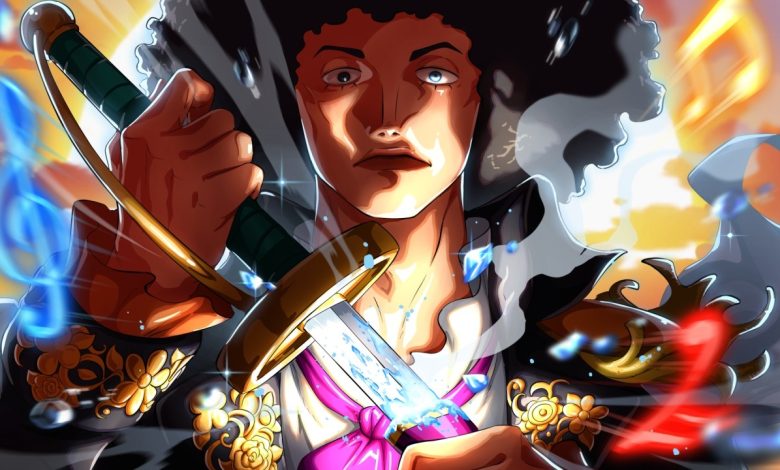
Warning: this article contains spoilers for One Piece chapter 1183.
Chapter 1183 opens a new flashback set 70 years before the current events and places Brook at the heart of the story. For the first time, the musician’s past is no longer limited to his time with the Rumbar Pirates and Laboon’s tragedy: it points back to the kingdom of Esperia, where Brook was once a soldier in the service of the crown.
This look into the past also brings several major mysteries to light. Princess Chouri appears to be connected to Gunko, King Ruen displays troubling characteristics, and Imu mentions someone named Dōzan, an individual who apparently died. These details are not definitive revelations yet, but they fuel one particularly ambitious theory: Brook could belong to a branch of the Davy clan and conceal an identity far more important than anyone imagined.
Brook was Esperia’s captain of the royal guard
The chapter takes the story back 70 years, or 18 years before Brook joined the Rumbar Pirates. He was 20 years old at the time. His position confirms and expands on long-standing information: before becoming a pirate, Brook belonged to the guard of a distant kingdom.
The wording used in this new passage directly echoes his earliest statements. Brook led a unit responsible for surprise attacks and served as captain of the royal guard. That kingdom now has a name: Esperia.
This detail also sheds light on Brook’s emotional reaction to Gunko. The little girl seen in the flashback is Princess Chouri, who is 7 years old. In the present, Brook identifies Gunko as Chouri. The issue is immediate: decades have passed, yet Gunko appears not to have aged in a way that matches such an enormous passage of time.
Brook also calls Chouri a regicide and a patricide: she would have killed her own father, Esperia’s king. Yet his reaction suggests that the truth is probably much more complex than a princess simply betraying her father.
Chouri, Gunko, and Esperia’s foretold tragedy
King Ruen is introduced as Brook’s great benefactor. At his side is Queen Candelle, Chouri’s mother and the former head of the royal defense force, whose reputation exceeded Brook’s before he joined the guard.
The kingdom is then attacked by the West Blue mafia. This setting belongs to a period when five powerful mafia families dominated that sea. Don Marlon was among them before joining the Rocks Pirates, while Capone Bege would later eliminate the heads of those families to become the godfather of West Blue.
However, the threat hanging over Esperia may go far beyond a mafia conflict. Brook explains that the kingdom disappeared, and One Piece has already shown that some islands can be erased when they become inconvenient to the World Government. Lulusia inevitably comes to mind in this context.
The very name Esperia supports this interpretation. It refers to the Hesperides of Greek mythology and to lands far to the west, where the sun sets. The idea of a “last light of the West” then resonates with Candelle’s name, which is associated with the light of a candle in darkness.
This symbolism of light connects to a phrase already used in relation to Imu: which light must be extinguished from the world? Without confirming that Esperia suffered the same fate as Lulusia, the chapter clearly establishes a setting in which the kingdom’s disappearance could be tied to a deliberate act of eradication.
Is King Ruen a Davy?
The most striking theory concerns King Ruen. His appearance strongly resembles Marshall D. Teach: a large build, facial features, and visual details that evoke Blackbeard. More importantly, Ruen is presented as the third character to share a trait attributed to the Davys.
This leads to the possibility that his true name could be Davy D. Ruen. He would then be a relative of Davy D. Xebec, perhaps an uncle or a close member of another branch of that family.
This possibility changes Esperia’s place in the world. God Valley would no longer necessarily be the Davy bloodline’s only home: several branches could have lived in West Blue, particularly in Esperia and God Valley. The fact that both places are associated with that sea makes the idea geographically coherent, though it does not turn it into a certainty.
The parallel with God Valley carries considerable weight. If Imu was already trying to eliminate the Davys at that time, Esperia’s disappearance could have been a similar operation carried out decades earlier. Brook may have survived because he had left the kingdom to pursue his dream of piracy, just as Teach may have been one of God Valley’s survivors.
Davy D. Brook: a theory based on his connection to Ruen
The chapter also shows Brook regularly addressing the king with a Japanese term that can mean “big brother,” while also serving as an expression for a leader, boss, or respected elder. That nuance is essential: it allows the word to be read as a sign of loyalty toward a ruler, but also as a potential clue of kinship.
The theory, then, is that Brook could be Ruen’s younger brother. His full name would become Davy D. Brook.
The theory does not rest on that expression alone. The reveal of Brook’s eyes strengthens the comparison with Teach: drooping eyes, similar eyelashes, comparable hair, and lips. Taken separately, those visual similarities prove nothing. Yet when brought together in a flashback devoted to a king who may be connected to the Davys, they become noteworthy.
Such a revelation could also explain why Brook may have been targeted long after Esperia’s fall. The Rumbar Pirates were exterminated by an enemy who remains unknown, using poisoned weapons. Brook did die in that attack, before the power of his Devil Fruit allowed him to find his body too late.
If those responsible were connected to the Holy Knights and acted for Imu, they would naturally have believed that they had eliminated Brook. His 50-year wandering in the Florian Triangle would then have prevented the world from learning that he had survived as a skeleton.
Esperia’s past continues in the chapter 1184 analysis focusing on Brook and the God’s Knights, followed by the article on the Manmeyer case and Esperia’s tragedy.
Is Candelle an infiltrated Manmeyer?
Another possibility places Queen Candelle at the center of the disaster. Her hairstyle recalls that of Gunko and the Manmeyer family. If Gunko is indeed Candelle’s daughter, and if her connection to the Manmeyers is confirmed, Candelle herself could come from that bloodline.
This theory imagines Candelle as a God’s Knight sent to Esperia to watch, infiltrate, or destroy a branch of the Davys. She would have had Chouri with Ruen before taking the child to Mary Geoise after the kingdom’s destruction. The pattern would echo Garling’s role at God Valley and his child being raised among the Celestial Dragons.
Under this interpretation, Chouri would have been manipulated by Imu, driven to kill her father, and then turned into Gunko. Gunko’s name, interpreted as “child soldier,” would reinforce her status as a victim rather than a true culprit. Brook may therefore be mistaken in directing his anger at her.
Nevertheless, this remains a theoretical construction. The chapter has not yet revealed Candelle’s true role or the circumstances of the regicide.
Who is Dōzan, the man Imu allegedly killed?
The chapter also mentions the name Dōzan, presented as an individual whom Imu allegedly killed. Since his name is written in katakana, it is clearly a proper name rather than a simple concept. But his identity remains completely open.
A first theory connects Dōzan to an ancient god of war, particularly because he is mentioned when Loki is involved. This possibility remains weak: it does not really explain why his name would be introduced in such a mysterious way.
A second proposal identifies Dōzan as the god of the earth, connected to Whitebeard’s Gura Gura no Mi. The name can be associated with images of mountains, ground, or ore, while Whitebeard’s power is directly linked to earthquakes and the ability to destroy the world. In this framework, Blackbeard would have continued that will after obtaining the Devil Fruit.
Finally, the possibility most closely tied to the chapter points to Brook. Dōzan Fujiwara is the stage name of a famous Japanese musician. That possible reference, combined with Brook’s “yohohoho” laugh and the importance of Bink’s Sake, raises the question of whether Dōzan could be an old name or alias for the musician.
Brook would then be not only a survivor of Esperia, but also a figure the World Government wanted to erase. His actual death among the Rumbar Pirates would have allowed Imu to believe he was gone, unaware that the Yomi Yomi no Mi had brought him back to life.
FAQ
Is Brook officially Davy D. Brook?
No. Chapter 1183 does not confirm that name. However, it provides visual and narrative elements that make the possibility plausible, notably the presumed connection between Brook, King Ruen, and the Davy clan.
Is Gunko really Princess Chouri?
Brook recognizes Gunko as Chouri, Esperia’s princess. Their connection therefore appears established in the story, but the reasons for her longevity, her presence beside Imu, and the king’s murder still need to be explained.
Is Dōzan Brook or Whitebeard?
No identity has been confirmed. Brook and Whitebeard are two separate theories: one rests on music, Bink’s Sake, and Brook’s apparent death; the other on the theme of earth and the Gura Gura no Mi.
Chapter 1183 thus turns Brook into a key character in the arc. His flashback does not appear to be intended merely to deepen his past: it could reveal a new branch of the Davy clan, clarify Gunko’s fate, and show how Esperia became another light threatened by Imu. This storyline can notably be viewed alongside the beginning of Luffy and Imu’s face-off in chapter 1186.
