

Warning: this article contains One Piece spoilers, including events up to Egghead.
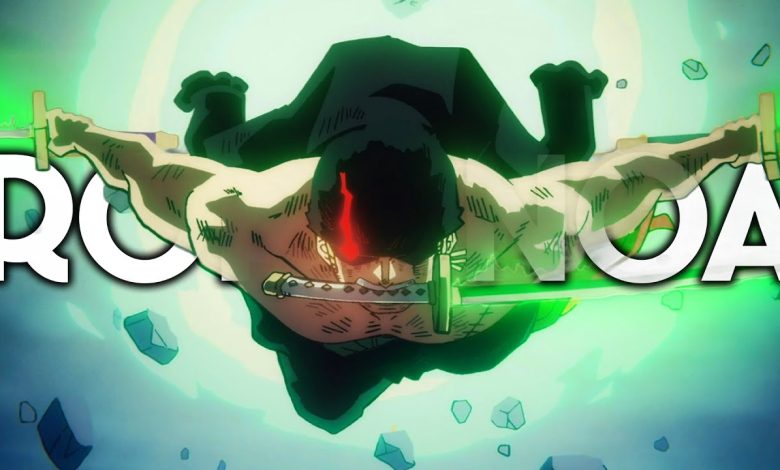
Roronoa Zoro is powerful for one very simple reason: he has turned his entire life into training. He has no Devil Fruit, is not portrayed as a genetically modified human, and relies on no external power to pursue his goal. His ambition is straightforward: to become the world’s greatest swordsman.
But his strength is not limited to his muscles or his katanas. Zoro grows because he turns every defeat, injury, and obstacle into another step forward. His mentality, his loyalty to Luffy, and his fighting sense explain his power just as much as his Santoryu techniques do.
Kuina: the origin of his ambition and mentality
Before joining Luffy, Zoro is a child obsessed with improving. At his dojo, he repeatedly faces Kuina and suffers 2,001 defeats. Yet that number does not define failure; above all, it shows his refusal to give up. Kuina is at once his rival, his friend, and the person capable of pushing him further.
After her death, their promise becomes the driving force of his entire life: one of them will become the world’s greatest swordsman. Zoro keeps Kuina’s sword and develops his three-sword style, Santoryu. That third blade is not merely an additional weapon: it carries the weight of his vow.
This origin explains a fundamental aspect of the character. Zoro does not fight only to win a duel. He fights to remain faithful to a promise. When he falls, he does not give up; he looks for what he lacks so that he can rise again stronger.
Nearly unreal physical endurance
From very early on, Zoro displays extraordinary resilience. Captured by the Marines after protecting a little girl, he remains tied to a post for nine days without food or water while enduring the guards’ humiliation and blows. This ordeal already reveals his character: pain is not enough to break his will.
When Luffy meets him, Zoro accepts the rice ball that has been crushed on the ground and offered to him. The gesture matters: despite his hunger and condition, he respects the child’s intention. Soon afterward, once he has recovered his swords, he single-handedly drives back the Marine soldiers.
His endurance then becomes one of his most consistent weapons. Injured by Buggy, he continues to act in order to save Luffy. At Arlong Park, still marked by his duel with Mihawk and deprived of two of his blades, he faces Hachi, a Fish-Man wielding six swords. Zoro wins despite his wounds and a clear disadvantage.
This ability to fight on the verge of exhaustion reaches its peak at Thriller Bark. Against Kuma, Zoro agrees to take on all of Luffy’s accumulated pain, fatigue, and suffering. He remains standing after this sacrifice without seeking any glory for it. The event does, however, leave him in a coma for three days. His devotion to his captain is explored further in the day Zoro took Luffy’s place against Kuma.
Mihawk teaches him what defeat truly means
The fight against Dracule Mihawk is humiliating, but it is also a turning point. Zoro challenges the world’s greatest swordsman far too early and is overwhelmed by a tiny knife. Yet, when he understands that he can no longer win, he refuses to turn his back on his opponent. For a swordsman, dying from a blow to the back would be shameful.
Mihawk recognizes his determination and draws Yoru, his black blade, to strike him. Zoro survives the wound that cuts across his chest and makes a decisive promise to Luffy: he will never lose again.
His mental strength also comes from that moment. Zoro does not claim to be invincible. He accepts being outmatched, but refuses to let that defeat be final. Later, after the two-year timeskip, he even kneels before Mihawk to ask for training. This choice is not weakness: Zoro puts aside his pride to serve his dream and become stronger support for the future Pirate King.
Santoryu and a fighter’s instinct
Zoro’s three-sword style is his signature. It allows him to combine striking power, multiple trajectories, and techniques such as Onigiri. However, Zoro is not so dependent on his weapons that he becomes helpless without them.
At Long Ring Long Land, he joins Sanji in a contest against two giants without being able to use his swords. He fights bare-handed, even generates tornadoes through the force of his strikes, and cooperates with his rival when the situation demands it. The rivalry between the two men never erases their effectiveness when they must defend the crew; discover why Sanji is so powerful in One Piece as well.
Above all, Zoro possesses remarkable combat instincts. At Whiskey Peak, he single-handedly disposes of an army of bounty hunters. At Little Garden, while immobilized by Mr. 3’s wax, he calmly considers amputating himself to survive. At Drum, he endures the cold bare-chested in order to strengthen his body and mind.
His relationship with blades also confirms his boldness. At Loguetown, he agrees to use Sandai Kitetsu, a cursed sword. To test it, he deliberately puts his arm at risk by allowing the blade to fall toward him. Zoro does not simply believe in fate: he challenges danger and accepts the consequences of his choices.
Learning to cut what seemed impossible
In Alabasta, Mr. 1 presents a major obstacle. Thanks to the Supa Supa no Mi, his body can become steel, a material Zoro does not yet know how to cut. The swordsman is badly injured and ends up trapped beneath the rubble of a building.
It is in this situation that he reaches a new level. Zoro senses the presence of the stones and understands his master’s lesson: to cut nothing is also to be able to cut everything. He must grasp the essence of what he seeks to cut. Once he reaches that understanding, he finally cuts through Mr. 1’s steel body and wins the duel.
This scene sums up his progression: Zoro does not merely increase his raw strength. He refines his perception, precision, and understanding of the sword. This principle can also be seen in the major combat systems of anime, explored in this guide to the main anime power systems.
Haki, Enma, and the King of Hell
After training with Mihawk, Zoro returns considerably stronger. He can cut an entire ship in half and destroy a Pacifista, whereas such an opponent had previously been an insurmountable wall for the crew. At Fish-Man Island, his lack of a Devil Fruit even becomes an advantage: he can fight underwater and defeat a Fish-Man in his own environment.
At Punk Hazard, his presence alone is enough to terrify Monet. At Dressrosa, he is launched toward Pica and cuts down this gigantic opponent. In Wano, his weapons and determination reach another level.
After returning Shusui to the land of Wano, Zoro receives Enma, the sword that once belonged to Oden. The weapon drains its user’s energy and proves difficult to control. Still, Zoro perseveres until he can wield it in battle. Against Kaido, he manages to wound him and reveals Conqueror’s Haki. He also withstands a combined attack from Kaido and Big Mom.
After being healed, he faces King, a Lunarian. This battle forces Zoro to understand how his opponent’s defense works: as long as flames burn on King’s back, he takes no damage. Zoro identifies this weakness, gains greater control over Enma, and establishes himself as the “King of Hell.”
Why Zoro remains a pillar of the Straw Hats
Zoro is powerful because he never separates his personal ambition from his role alongside Luffy. He wants to become the world’s greatest swordsman, but he also wants to be strong enough to support the man who will become the Pirate King.
At Egghead, he once again shows his vigilance by reacting to Kaku’s surprise attack. He also observes the Seraphim and understands their connection to King’s defensive abilities. Even when he gets lost or sleeps deeply, Zoro remains an attentive fighter guided by sharp instincts.
His strength therefore comes from a rare combination: daily training, extreme endurance, unshakable willpower, evolving swordsmanship, and absolute loyalty. Every battle brings him closer to Mihawk, the opponent he must one day surpass to fulfill the promise he made to Kuina.
FAQ: Zoro’s power
Does Zoro have a Devil Fruit?
No. Zoro has not eaten a Devil Fruit. He fights through his Santoryu, training, endurance, and growing mastery of Haki.
Why does Zoro use three swords?
His style, Santoryu, relies on three blades, including one held in his mouth. After Kuina’s death, Zoro also carries her sword to honor their promise to become the world’s greatest swordsman.
What is Zoro’s great promise to Luffy?
After his defeat against Mihawk, Zoro promises Luffy that he will never lose a fight again. This promise fuels his determination in the most dangerous confrontations.
Why is Enma so difficult to master?
Enma drains its wielder’s life force. Zoro must therefore learn to control his use of Haki and the power released by the blade to avoid being overwhelmed.
