

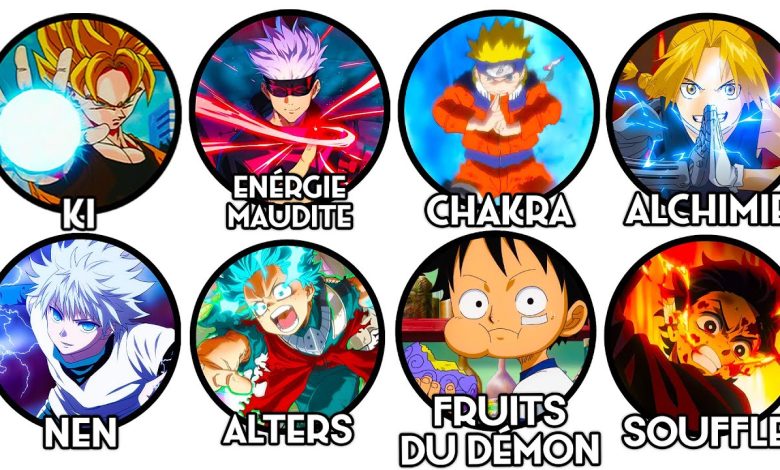
Major anime are not built solely around powerful heroes: they structure their confrontations around precise rules. Ki, chakra, Nen, and cursed energy provide a framework for techniques, transformations, and strategies. Each system also sets limits, making battles easier to follow and often more creative.
Here are the main anime and manga power systems, along with how they essentially work.
Ki in Dragon Ball: vital energy at the heart of combat
In Dragon Ball, Ki is the fundamental energy fighters draw upon to surpass ordinary human abilities. Present in every living being, this energy can be controlled and used to increase strength, speed, and durability.
Ki consists of three dimensions: Genki, linked to physical energy; Yoki, associated with courage; and Shoki, which refers to mental energy. Mastering it allows fighters to fly, launch energy attacks, and sense the power of other individuals, even when they are far away or hidden.
The Kamehameha perfectly illustrates this offensive use of Ki. Fighters can also train to control their energy more effectively and become more efficient in battle. For a closer look, explore Dragon Ball techniques explained, from iconic attacks to their tactical uses.
Stands in JoJo’s Bizarre Adventure: the spirit in visible form
Stands are the manifestation of an individual’s fighting spirit in JoJo’s Bizarre Adventure. Introduced in Part 3, Stardust Crusaders, they are at the center of confrontations between their users.
A Stand can take many different forms: a humanoid creature, an object, a phenomenon, or a more abstract entity. Every Stand is defined by its appearance, its method of manifestation, and above all, its unique ability. Their names frequently reference music.
Some possess exceptional strength or speed, while others manipulate far more complex concepts, such as time, space, or reality. A Stand’s power is closely tied to its user’s will and determination. As a result, confrontations require as much thought as brute force.
Chakra in Naruto: physical and spiritual energy
Chakra is the foundation of most ninjutsu in Naruto. It is created through the combination of physical and spiritual energy. All living beings possess it, but the ability to manipulate it distinguishes ninjas capable of performing jutsu.
A ninja must measure and shape their chakra to perform a given technique, whether it is the Multi Shadow Clone Jutsu or elemental attacks. The five basic affinities are fire, water, wind, earth, and lightning. More advanced natures also exist, including Yin and Yang Release.
Control is decisive: strong mastery allows a user to perform more techniques while expending less energy. The chakra of the tailed beasts, possessed by the Bijū and their jinchūriki, is presented as far more powerful than ordinary chakra. Hereditary and ocular powers further expand this system; see Naruto and Boruto’s dōjutsu to understand abilities connected to the eyes.
Alchemy in Fullmetal Alchemist: transforming without creating freely
The alchemy of Fullmetal Alchemist is both a science and an art of transmuting matter. Alchemists use transmutation circles to perform the necessary calculations and channel their energy.
Its central principle is equivalent exchange: obtaining something requires sacrificing something of equivalent value. Alchemy can be used to create weapons, raise barriers, or heal. However, the more complex a transmutation is, the more knowledge and mastery it requires.
Human transmutation is strictly forbidden because of its consequences. Philosopher’s Stones, meanwhile, are extremely powerful amplifiers capable of bypassing the ordinary limits of equivalent exchange, but their creation involves sacrificing numerous human lives.
Quirks in My Hero Academia: abilities built into society
In My Hero Academia, Quirks are superhuman abilities that emerged around two hundred years earlier. Most of the population is now born with a Quirk, which generally manifests before the age of four.
They fall into three broad categories. Emitter Quirks allow users to release a substance or affect materials. Transformation Quirks temporarily alter the body, notably to enhance physical abilities. Mutant Quirks involve permanent bodily changes, such as animal features or additional limbs.
A Quirk’s power varies greatly depending on its nature and its user. Quirks can be passed down within a family and combined in descendants. Training remains essential to learn how to use them safely, whether in a heroic or criminal vocation.
Devil Fruits and Haki: One Piece’s two pillars
Devil Fruits grant rare supernatural abilities in One Piece. Paramecia can alter the body, the environment, or produce substances. Zoan allow animal or hybrid transformations. Logia grant the ability to create, control, and become a natural element or force of nature.
This power comes with a major drawback: anyone who eats a Devil Fruit loses the ability to swim and becomes helpless in water. The risk is even greater because a fruit guarantees neither a desired power nor immediate mastery of it.
Haki is a latent force present in living beings, accessible to a limited number of individuals. Observation Haki allows users to sense presence, strength, and emotions, and at an advanced level, briefly glimpse the future. Armament Haki strengthens offense and defense while allowing users to touch Logia users. Finally, Conqueror’s Haki, which is extremely rare, imposes its wielder’s will on weaker people.
To complement this overview, discover the races and peoples of One Piece, which also contribute to the diversity of abilities in this universe.
Nen in Hunter x Hunter: aura as a strategic tool
Nen allows living beings to manipulate their aura, an energy tied to the soul that surrounds the body. Mastering it requires rigorous training, discipline, and a nuanced understanding of one’s own limits.
Its six fundamental principles are Ten, Zetsu, Ren, Hatsu, Gyo, and Ken. Users are also divided among six affinity categories: Enhancement, Emission, Manipulation, Transmutation, Conjuration, and Specialization.
An ability’s strength does not rely solely on raw power. It depends on the balance between the fighter’s natural affinity, creativity, and training. This is what makes Nen one of the most strategic systems: an apparently simple ability can become formidable when used intelligently.
Cursed energy, spiritual power, and devils
In Jujutsu Kaisen, cursed energy is born from negative human emotions such as fear, anger, and hatred. It can create cursed spirits, but sorcerers can also control it to perform techniques unique to each individual. Domain Expansions create a space in which the user gains a considerable advantage, but using them requires precise control to avoid exhaustion.
In Bleach, ryoku, or spiritual power, fuels the abilities of spiritual beings. When it is exceptionally high, it can generate spiritual pressure capable of intimidating or incapacitating an opponent. It notably powers Shinigami Kidō spells and Hollow energy attacks.
Chainsaw Man follows a different logic: devils embody humanity’s fears. Their power depends directly on the intensity of the fear they inspire. They can make contracts with humans, regenerate by consuming blood, and take various forms. Fiends are devils that have taken over a human corpse, while hybrids retain human consciousness while being able to use devil powers.
Titans and Breathing Styles: powers rooted in the body
Titan power in Attack on Titan allows certain humans to transform into humanoid giants. The nine original Titans each possess unique characteristics, from the Colossus Titan to the War Hammer Titan. Their inheritance is passed on by consuming a previous holder, but every successor is subject to Ymir’s Curse, which limits their life to thirteen years.
In Demon Slayer, Breathing Styles are martial arts based on breathing techniques that enhance Demon Slayers’ physical abilities. Sun Breathing is presented as the first and most powerful style, from which the others originated. Water, Flame, Flower, or Sound: each Breathing Style has its own techniques and identity. Mastery depends as much on physical condition as on training, and some Demon Slayers develop their own variations.
FAQ about anime power systems
Which power system is the most strategic?
Hunter x Hunter‘s Nen stands out because of the importance of affinity, personal rules, creativity, and analyzing one’s opponent. Stand battles and fights based on cursed energy also place great emphasis on strategy.
What is the difference between a Devil Fruit and Haki?
A Devil Fruit grants a specific ability after being consumed, with the inability to swim as its drawback. Haki is a latent force tied to spiritual energy that must be awakened and mastered.
Why are limits important in a power system?
Limits prevent abilities from resolving every conflict effortlessly. Energy consumption, activation conditions, training, and physical drawbacks create stakes and encourage more inventive confrontations.
