

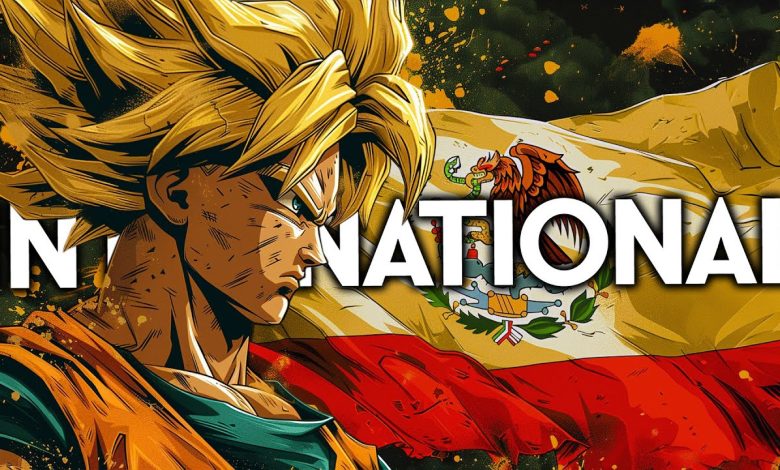
Mexico holds a special place in the international history of Dragon Ball. The series is known across several generations, appearing in businesses, popular references, and major fan gatherings. That passion took an exceptional turn in 2018, when the final episodes of Dragon Ball Super aired.
What was meant to be a collective celebration of Goku versus Jiren became a copyright tug-of-war. Toei Animation, followed by the Japanese embassy, opposed the planned public screenings on giant screens. Yet the announced cancellation was not enough to calm a community determined to experience the event together.
Why Dragon Ball Is So Popular in Mexico
The popularity of Japanese animation in Latin America can first be explained by its arrival at a time when American programming was expensive to acquire. During the 1970s, broadcasters in the region were looking for affordable content. Japan offered licenses at attractive prices, notably through Toei Animation.
Series such as Captain Tsubasa, Saint Seiya, and Dragon Ball found especially fertile ground. In Mexico, the success of Saint Seiya helped establish Japanese animation as a lasting part of television habits. The series received much broader exposure there than it did in the United States, with 114 episodes, four feature films, and four OVAs, with no censorship reported in the broadcast content.
This precedent encouraged Mexican television to air Dragon Ball in the early 1990s. The series was widely broadcast, with time slots before and after school. Above all, it was shown in order, from Dragon Ball to Dragon Ball Z and then Dragon Ball GT, without the cuts that affected some French broadcasts.
That continuity mattered greatly. In Mexico, viewers grew up with Goku, followed his transformations, and passed the series on to the next generation. Saiyans and their evolutions remain central to the franchise’s imagination, as explained in our guide to Super Saiyan forms and Saiyan transformations.
A Work Embedded in Popular Culture
Mexican enthusiasm goes beyond ratings. Businesses display Dragon Ball characters on their storefronts, and in some villages, activity can slow down when an episode airs. Goku has become an instantly recognizable figure, sometimes described as more famous than Mickey Mouse.
The phonetic similarity between “Son Goku” and the Spanish word san, used to refer to a saint, has also caused confusion. Some people have understood “San Goku” as “Saint Goku.” This anecdote illustrates how deeply the franchise has taken root in a country where religious references carry strong cultural weight.
The phenomenon has continued online. Google searches and viewing statistics for fights associated with the Spanish language show massive interest across several Latin American countries. Mexico ranks among the most engaged countries, but this passion is shared throughout the region.
Gohan Blanco and El Hermano: When Fans Extend Dragon Ball
After the end of Dragon Ball GT, the lack of an official sequel for many years fueled immense fan creativity. The image of Super Saiyan 5 Goku, often associated with the fake Dragon Ball AF project, became especially famous. However, it did not come from an official production: it originated as fan art sent to a Spanish magazine.
In Mexico and other Spanish-speaking communities, this culture of fan art and theories grew enormously. Imaginary stories emerged around characters such as Gohan Blanco, an overpowered version of Gohan, and El Hermano, portrayed in these creations as Jiren’s older brother.
In one of these fan stories, Gohan Blanco becomes the protagonist of a deliberately extravagant scenario featuring the Grand Priest under another identity, Golden Cell, and even Shaggy from Scooby-Doo. El Hermano, meanwhile, is imagined as a figure tied to Jiren’s dark past, in a plot reminiscent of the relationship between Sasuke and Itachi.
These stories are not part of the Dragon Ball canon. They nevertheless show the intensity with which fans embraced the universe, its races, its characters, and its battle rules. For a clearer view of this universe’s foundations, see our overview of Dragon Ball races.
The release of Dragon Ball Super: Super Hero in 2022 revived comparisons when Gohan gained his Beast form. Some Latin American viewers saw it as a symbolic confirmation of their older Gohan Blanco creations, even though these fan theories and official content remain separate.
Dragon Ball Super Episodes 130 and 131: The Forbidden Celebration
On March 17, 2018, the airing of episodes 130 and 131 of Dragon Ball Super generated immense anticipation. The Tournament of Power was nearing its conclusion, following the emergence of Ultra Instinct and the battle between Goku and Jiren. Students in Ciudad Juárez then wanted to organize a public screening to bring fans together.
Mayor Armando Cabada initially supported the idea. He publicly mentioned festivities dedicated to Universe 7, with references to Zeno and the Grand Priest. But broadcasting an episode in a public square is not the same as watching it with friends: it requires authorization from the rights holders.
Toei Animation therefore opposed these unauthorized screenings. The Japanese embassy also sent letters to Mexican authorities stating that episodes 130 and 131, which were protected by copyright, were going to be shown in public places without the required permission. The Japanese government asked for the situation to be handled in accordance with copyright law.
The phrase “war between Japan and Mexico” was clearly an exaggeration. This was not a diplomatic conflict in the strict sense, but a striking cultural and legal controversy. Given the scale of the planned gatherings, the rights holders sought to protect their work and prevent unlicensed public screenings from becoming the norm.
15,000 Fans Gathered to Watch Goku Versus Jiren
The cancellation of the official events did not end the mobilization. One solution was suggested: subscribe to Crunchyroll legally, then invite friends over to watch the episode. In practice, the number of “friends” went far beyond the confines of a living room.
At Plaza de la X in Ciudad Juárez, around 15,000 people gathered to watch Dragon Ball Super. Other Mexican public squares also welcomed crowds eager to follow the conclusion of the Tournament of Power. Fans shouted, sang, and shared a collective moment centered on Goku.
This mobilization sums up what Dragon Ball represents in Mexico: far more than a popular anime. The franchise has become a common language, passed down among loved ones and capable of turning the broadcast of an episode into a genuine national event. Everyone knows the attacks and transformations, from the Kamehameha to Ultra Instinct; our article on Dragon Ball techniques also shows why this vocabulary has made such an impact.
FAQ
Why did Toei Animation want to stop the screenings in Mexico?
The Dragon Ball Super episodes were planned for public venues without the proper authorization. Toei Animation was therefore defending its broadcasting and copyright rights.
Did Japan and Mexico really go to war over Dragon Ball?
No. It was a dispute over unauthorized public screenings, relayed by the Japanese embassy, not a conflict between the two countries.
Are Gohan Blanco and El Hermano part of official Dragon Ball?
No. Gohan Blanco and El Hermano come from fan creations, theories, and animations that became popular in Spanish-speaking communities.
Why did the end of Dragon Ball Super mobilize so many people?
Episodes 130 and 131 concluded the Tournament of Power, with Goku, Jiren, and Ultra Instinct at the center of attention. In a country where the franchise brings together several generations, anticipation was especially high.
