

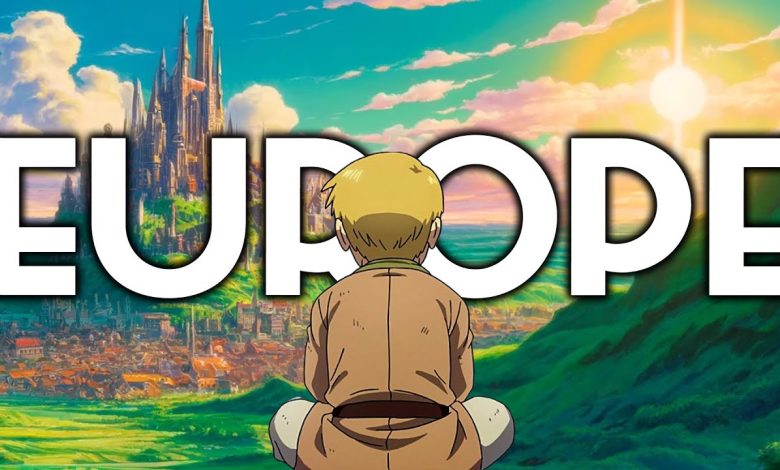
Monumental castles, walled cities, lush countryside, Alpine villages, kingdoms at war, and the narrow streets of old major cities: Europe is everywhere in the imagination of Japanese animation. It may be realistic, reimagined, or completely fantastical, but it very often provides the setting for stories that have become classics.
This presence is not merely a matter of aesthetics. Japanese creators find in it a space well suited to adventure, wonder, historical drama, and social criticism. From Heidi to Vinland Saga, including Hayao Miyazaki, Fullmetal Alchemist, and Attack on Titan, Europe makes it possible to tell universal stories while creating distance from contemporary Japan.
A fascination born from Japan’s opening to the world
Japanese curiosity about Europe is part of a long history. From 1650 onward, Japan entered a period of isolation known as sakoku, literally meaning the closure of the country. For more than two centuries, contact with the rest of the world was extremely limited.
Some exchanges nevertheless continued with the Dutch, Chinese, and Koreans. The occasional presence of foreigners, especially on roads or in villages, fostered a fascination with these distant and little-known worlds.
The forced opening of the country by the United States in the 19th century profoundly changed the situation. During the Meiji period, Japan recognized its technological gap with foreign powers and turned toward Europe: its industry, architecture, arts, and ways of life became major subjects of interest.
This cultural attraction continued in fiction. Europe was not just a real place: it became a reservoir of powerful imagery associated with castles, nobles, armies, old cities, and a turbulent history.
Heidi, a turning point for Europe in Japanese animation
Aired in the 1970s, Heidi tells the story of a child living in the Swiss Alps with Peter, Clara, and her dog Hercules. Beneath the apparent simplicity of its story, the series holds an important place in the history of Japanese animation.
Hayao Miyazaki, still far from founding Studio Ghibli at the time, contributed to this adaptation. In order to make the landscapes credible, he traveled to Switzerland himself with his team. This approach already showed a desire not to reduce Europe to a vague backdrop: the mountains, villages, and natural spaces had to convey the feeling of a living world.
The success of Heidi encouraged the World Masterpiece Theater studio to adapt more European stories. A formula took hold: children go through hardships in a rural, green Europe set in a past that is difficult to date, often close to the 19th century.
This idealized Europe is sometimes called “Ruritania”: an imaginary country of castles, peasants, nobles, and old traditions. It offers a strong contrast with a modern world perceived as more industrial, faster, and more corrupt.
France as a setting for freedom and social criticism
Europe also makes it possible to explore more sensitive themes. The Rose of Versailles, set in France during the French Revolution, is a striking example. Its heroine, Oscar de Jarjayes, is raised as a man by her father and trained in fencing and horseback riding before joining the royal guard.
Her appearance and position create an ambiguity that contributes to the work’s popularity in Japan. Yet the story goes far beyond romance: Oscar discovers a France marked by corruption and ultimately joins the revolutionary cause.
The French setting makes subjects such as revolution, the overthrow of power, inequality, and ambiguous romantic relationships possible. Transposing these issues to historical Europe gives authors a particular freedom to question their own society indirectly.
Hayao Miyazaki and a reimagined Europe
After Heidi, Hayao Miyazaki continued this creative relationship with Europe. His travels fed into composite cities that do not reproduce a single location but bring together several inspirations. Kiki’s Delivery Service, in particular, evokes Stockholm, Paris, and Lisbon through its cafés and tramway.
In his films, Europe rarely becomes a simple historical backdrop. It is transformed by imagination: old architecture can stand alongside machines, airships, and steampunk elements. Howl’s Moving Castle especially captures this blend of recognizable Europe and a universe impossible to place precisely.
This aesthetic also serves major themes: war, corruption, industrialization, and the human consequences of innovation. In Porco Rosso, the story of a pilot transformed into a pig explores nostalgia, solitude, and the scars of war. Howl’s Moving Castle likewise portrays technology as fascinating, yet potentially terrifying when it becomes an instrument of destruction.
A timeless Europe in major manga and anime
Fullmetal Alchemist continues this tradition with Amestris, a country heavily inspired by early 20th-century Western and Central Europe. The names Edward and Alphonse Elric, the trains, early automobiles, army, and propaganda establish a world close to reality, enriched by alchemy, chimeras, and homunculi.
This alliance of historical references and fantasy makes it possible to address war, the police state, and the pursuit of military power. Europe becomes a setting familiar enough to be immediately readable, yet distant enough to accommodate an original mythology.
The same mechanism appears in Attack on Titan. Its walled cities can recall European fortified towns, while names such as Eren Jaeger, Armin Arlert, and Ymir Fritz reinforce its Germanic tone. Trains, cannons, warships, and aviation blend into an era deliberately difficult to pin down.
In this world, Titans replace weapons of mass destruction amid fear, oppression, and conflict. The European setting thus serves a story about freedom, the cycle of hatred, and war. To explore these human and tragic stakes further, see our feature on the most horrific deaths in Attack on Titan.
Vinland Saga: from imagined Europe to historical Europe
With Vinland Saga, the approach changes. Makoto Yukimura’s work does not primarily seek to build an ideal or magical Europe. It draws on history, Icelandic sagas, and characters connected to real figures, such as Thorfinn Karlsefni and King Cnut the Great.
Its Europe is brutal: the war between Denmark and England makes survival a constant concern. The story retains considerable dramatic power, but its setting leans toward a much harsher realism than that of fantasy kingdoms.
Europe can also appear in fragments within much broader universes. In One Piece, Dressrosa combines several references: Don Quixote and flamenco point to Spain, while the coliseum and gladiatorial fights evoke Italy. Kings, princesses, betrayals, and the oppression of the population give this arc a very strong European identity. This diversity adds to the overall richness of the series’ peoples, explored in our article on the races and peoples of One Piece.
Why isekai keeps returning to European fantasy
The isekai genre takes this fascination even further. Its premise often centers on a Japanese adult who dies and is then reincarnated in another world. This new beginning frequently takes place in a fantasy Europe: knights, magic, kingdoms, medieval towns, armies, and castles form the usual setting.
In Mushoku Tensei, for example, the protagonist is reborn in such a universe and seeks to rebuild his life. The imaginary European world then becomes a space for a second chance, with a progression system close to role-playing games: learning spells, growing stronger, and overcoming obstacles.
This influence extends beyond anime. Japanese games such as Dragon Quest and Zelda also rely on feudal kingdoms, dragons, armor, gods, and wars. Medieval and fantasy Europe functions as an immediately understandable language for telling stories of adventure.
FAQ: Europe in anime
Why do anime use so many castles and fortified cities?
European castles, walls, and kingdoms immediately evoke history, power, war, and adventure. They are especially well suited to fantasy stories, political dramas, and tales of rebellion.
Are European anime settings faithful to reality?
They can be inspired by real places, such as the Swiss Alps in Heidi, but they are often recomposed. Many fictional worlds combine several countries, eras, and architectural styles to create an imaginary Europe.
Why is Europe so present in isekai?
The European medieval fantasy world provides an ideal framework for magic, chivalry, royalty, and personal progression. It allows characters to start over in a universe far removed from modern Japan.
