

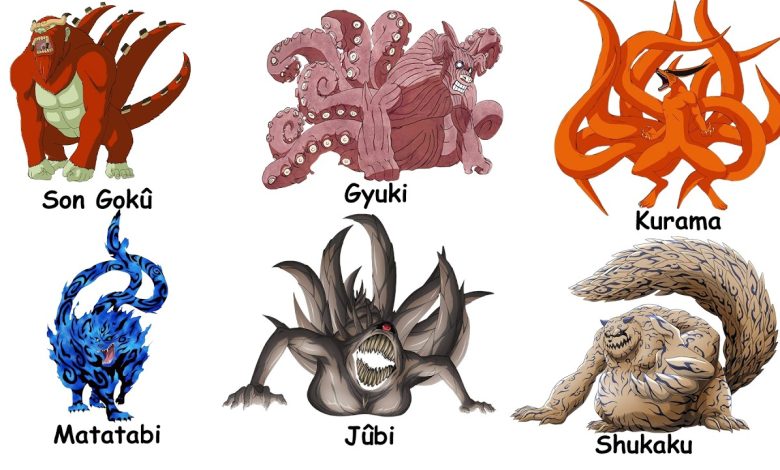
The tailed beasts, or Bijū, are among the most important forces in the world of Naruto. Long regarded as mere weapons capable of destroying villages, they are actually chakra beings with personalities, memories, and a deep desire for freedom.
They were born when Hagoromo Ōtsutsuki, the Sage of Six Paths, divided the Ten-Tails’ chakra into nine distinct entities. Each has a number of tails, its own appearance, unique techniques and, in most cases, a human host known as a jinchūriki. Above all, their story is one of gradual change: a journey from fear and exploitation toward mutual respect.
Shukaku, the One-Tail
Shukaku is a creature resembling a giant tanuki and is associated with sand. Chaotic, proud, and combative by nature, he initially harbors a fierce hatred for humans, who reduced him to a tool of war.
His best-known jinchūriki is Gaara of the Hidden Sand Village. Shukaku’s presence forces Gaara to suffer from permanent insomnia and helps turn him into a merciless fighter during his childhood. However, their relationship eventually develops into a form of respect, even after they are separated.
Shukaku is portrayed as the least powerful Bijū in terms of raw strength, but he remains extremely dangerous. He controls sand, can raise massive barriers, and uses both Wind Release and Magnet Release. His sand notably has sealing properties capable of restraining enemies.
Matatabi, the Two-Tails
Matatabi takes the form of a gigantic blue cat surrounded by flames. This Bijū stands out through her grace, her sense of honor, and a more measured attitude than that of several of her counterparts.
She is sealed within Yugito Nii, a kunoichi from the Hidden Cloud Village. Their understanding allows Yugito to use Matatabi’s energy and formidable fire-based abilities with precision, including intense flames and gigantic fireballs.
The pair illustrates the possibility of balanced cooperation between a jinchūriki and their Bijū. After Yugito’s death, Matatabi is captured by the Akatsuki and sealed inside the Gedō Mazō statue before being released near the end of the story.
Isobu, the Three-Tails
Isobu is an enormous turtle-like creature with three tails resembling shrimp. His story is tied to Rin Nohara, a member of Minato’s team. The Hidden Mist Village had sealed him inside her in order to use her against Konoha.
However, Rin chooses to sacrifice herself and forces Kakashi to kill her before she reaches the village, preventing the attack. Isobu later returns to life and is sealed within Yagura Karatachi, the Fourth Mizukage. Following Yagura’s death, he remains free for a time before being captured by the Akatsuki.
Reserved, formal, and cautious, Isobu avoids unnecessary confrontations. He masters water and can create enormous masses of liquid or tidal waves. His Coral Palm technique immobilizes and injures opponents, while his Tailed Beast Bomb concentrates immense destructive chakra.
Son Gokū, the Four-Tails
Son Gokū resembles a gigantic monkey with a blazing mane. His name refers to the Monkey King of Chinese mythology, and he shares a famous namesake with the hero of Dragon Ball.
Sealed within Rōshi, a shinobi from the Hidden Stone Village, Son Gokū deeply despises humans because of the way the Bijū have been treated. Yet he remains attached to the name Hagoromo gave him. During the Fourth Great Ninja War, he eventually forms a bond with Naruto and fights alongside the other tailed beasts against Obito and Madara Uchiha.
His specialty is Lava Release, a combination of Fire and Earth chakra. He can produce molten lava and unleash the Flower Fruit Mountain technique, which causes a volcano to rise up and engulf his opponent.
Kokuō and Saiken: Scalding Steam and Corrosive Mucus
Kokuō, the Five-Tails, is a hybrid of a horse and a dolphin. He was sealed within Han of the Hidden Stone Village. He uses Boil Release, a power that combines Fire and Water to generate steam that greatly increases its user’s strength.
Despite his destructive potential, Kokuō is generally peaceful and avoids needless conflict. After being extracted from Han by the Akatsuki, he is ultimately freed during the war. He later chooses to live freely and apart from others.
Saiken, the Six-Tails, has the appearance of a giant slug. His primary weapon is viscous, corrosive mucus capable of trapping or dissolving his targets. He can also form acidic bubbles that burst on contact.
His jinchūriki, Utakata of the Hidden Mist Village, struggles with his status. Their relationship gradually strengthens until Utakata accepts Saiken as part of his identity. The Akatsuki then captures Saiken, causing Utakata’s death. After the war, the Bijū regains his freedom.
Chōmei and Gyūki, Two Very Different Alliances
Chōmei is the Seven-Tails. He resembles a huge armored beetle whose tails evoke insect wings. Able to fly at high speed, he scatters a powder that can blind his enemies.
He is sealed within Fū, a kunoichi from the Hidden Waterfall Village. Energetic, cheerful, and outgoing, Fū maintains a friendly relationship with Chōmei and faces little discrimination in her village. Nevertheless, her fate becomes tragic when the Akatsuki capture her and extract the Seven-Tails.
Gyūki, the Eight-Tails, is a creature with an ox’s head and octopus tentacles. His jinchūriki is Killer B of the Hidden Cloud Village. Their partnership is one of the most harmonious in the series: Killer B treats Gyūki as a true ally rather than a weapon.
Calm, clear-minded, and fiercely attached to freedom, Gyūki fights in perfect coordination with his host. He possesses immense strength, vast chakra reserves, formidable tentacles, and an ink technique that allows him to create clones. Their role is crucial during the Fourth Great Ninja War, much like the major confrontations explored in this look at Jujutsu Kaisen’s climactic journey.
Kurama, the Nine-Tails
Kurama is the most powerful of the nine Bijū. His immense chakra, strength, and reputation for malice make him a creature feared by every shinobi. Before Naruto, he is sealed within Kushina Uzumaki.
On the day Naruto is born, Obito Uchiha releases Kurama and attacks Konoha. Minato and Kushina then sacrifice themselves to seal half of the fox inside their son, convinced that he will one day be able to master this power.
At first, Kurama seeks to exploit Naruto’s anger and loneliness in order to take control of his body. Naruto eventually learns to understand his suffering and earns his trust. Their relationship becomes the strongest example of cooperation between a human and a Bijū. This evolution recalls how long-running shonen stories can turn inner conflict into a defining source of growth, as seen in Robin’s Demonio form in One Piece.
With Kurama, Naruto fights Obito, Madara, and Kaguya Ōtsutsuki, among others. In Boruto, Kurama sacrifices himself during the battle against Isshiki Ōtsutsuki to enable Baryon Mode, which consumes their shared chakra at the cost of the fox’s life.
The Ten-Tails, Origin of the Nine Bijū
The Ten-Tails, or Jūbi, is the original source of the Bijū. It was born from the fusion of Kaguya Ōtsutsuki and the Divine Tree. A gigantic creature with one eye, the Rinne Sharingan, and ten tails capable of devastating entire regions, it embodies raw power almost entirely devoid of consciousness.
Its only instinct is to reclaim the chakra taken from it. It possesses nearly limitless chakra, can fire devastating Tailed Beast Bombs, manipulate natural energy, and trigger the Infinite Tsukuyomi.
Hagoromo and Hamura manage to seal it away, with Hagoromo becoming the first jinchūriki. Later, to prevent this threat from returning, he divides the Ten-Tails’ chakra into nine beings: Shukaku, Matatabi, Isobu, Son Gokū, Kokuō, Saiken, Chōmei, Gyūki, and Kurama.
The Ten-Tails’ resurrection during the Fourth Great Ninja War marks a major turning point. Controlled in succession by Obito and then Madara, it ultimately serves as the catalyst for Kaguya’s return. Naruto and Sasuke manage to seal her, freeing the Bijū and ending the threat of the Ten-Tails.
Naruto Tailed Beasts FAQ
How many tailed beasts are there in Naruto?
There are nine Bijū, created from the Ten-Tails’ chakra by Hagoromo Ōtsutsuki. The Ten-Tails is the original ten-tailed demon and the source of their power.
Which tailed beast is the strongest?
Kurama, the Nine-Tailed Fox, is presented as the strongest among the nine Bijū. However, the Ten-Tails vastly surpasses them because it is the origin of their chakra.
Why are jinchūriki important?
Jinchūriki serve as hosts for the Bijū. Their relationship with the creature sealed within them can be conflict-ridden, as it initially is for Gaara and Shukaku, or grow into a genuine alliance, as it does between Killer B and Gyūki, and later Naruto and Kurama.
