

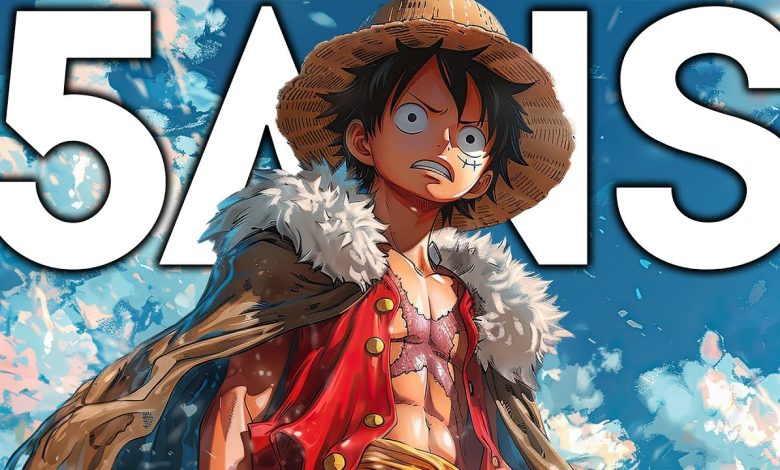
When One Piece began in Weekly Shonen Jump on July 19, 1997, Eiichiro Oda did not yet envision a work spanning more than a thousand chapters. The manga creator had planned a much shorter adventure: around five years of publication, or roughly 250 chapters.
That idea seems staggering today. At that point in the story, chapter 250 falls in the middle of Skypiea, long before many major turning points. Yet this initial project helps explain the work’s underlying structure: a quest for the One Piece, major pirates to defeat, and a huge final war.
The version ultimately published expanded considerably, but it has retained several pillars established in its earliest arcs.
An author who prepares his biggest mysteries
Oda is known for planting elements whose importance only becomes apparent much later. This writing technique, often called foreshadowing, involves slipping in clues that point to future characters, conflicts, or revelations.
A striking example appears in chapter 98. As Luffy is about to be executed in Loguetown and Monkey D. Dragon intervenes, a young man wearing a hat appears discreetly in the crowd. This is Sabo, whose role would not truly be developed until chapter 583.
This kind of visual callback reinforces the feeling that the world of One Piece is never built at random. In 1999, Oda stated that he had already decided on the final page and the form of the final chapter. He also explained that the final saga would focus both on the Straw Hats and on events affecting the entire world.
The challenge, then, was not the existence of an ending, but the time needed to reach it.
The original plan: the Straw Hats against the Emperors
According to Oda, the heart of the story was meant to be relatively simple: Luffy and his crew would face the Four Emperors, the most powerful pirates on the seas. This foundation offered a clear progression, with major opponents to bring down before reaching the One Piece.
The complication came from characters who became far more important than expected: the Seven Warlords of the Sea. Oda has explained that their introduction upended his plans and greatly contributed to the series becoming longer.
The Supernovas also enriched the narrative. Trafalgar Law, Eustass Kid, and the other young pirates were not part of the most direct framework of the original story. Their arrival opened up new rivalries, alliances, and individual paths, while giving the New World additional depth.
This abundance is both a strength and a constraint. It makes the universe feel more alive, but it inevitably took One Piece far beyond the five-year format initially envisioned.
The early characters were never abandoned
The first chapters already introduce figures who remain central to the future of the pirate world. Shanks is present from the beginning: he saves Luffy, entrusts him with his straw hat, and becomes the model who inspires the hero to set sail.
Buggy, once merely an East Blue rival, has also risen spectacularly to the rank of Emperor. Crocodile, the first major antagonist defeated by Luffy, remains connected to major developments, notably alongside Buggy.
Vivi Nefertari, who travels with the crew throughout much of the Alabasta saga, has likewise become an essential figure. Her place within the Nefertari family and among Im’s priority targets directly ties her to the work’s most important political mysteries.
Finally, Blackbeard is introduced relatively early as Luffy’s dark mirror: a pirate driven by a dream, but willing to follow a radically different path. His first meeting with Luffy in Jaya already establishes the opposition between two visions of piracy and freedom.
This continuity explains why the beginning of the series remains so important. Characters established in the first 250 to 300 chapters can still influence the events of the final saga.
Alabasta, a possible blueprint for the ending
The Alabasta arc is one of the first stories in which Oda brings together so many decisive elements: a kingdom in crisis, a criminal organization, a royal family, a Warlord, a Poneglyph, and Nico Robin joining the crew.
Crocodile manipulates Alabasta from the shadows, seeks to exploit the kingdom, and searches for information hidden in the palace Poneglyph. This stone block mentions Pluton, an Ancient Weapon. Much later, Wano is also linked to Pluton and to a Poneglyph buried beneath the country.
The parallel does not mean that Alabasta alone summarized the entire planned conclusion, but it shows that the major themes were already present: the Ancient Weapons, the legacy of kingdoms, the Poneglyphs, and the role of the Nefertari bloodline.
Nico Robin therefore becomes indispensable to the quest. She can decipher the Poneglyphs, some of which point to locations or recount ancient history. The Road Poneglyphs, recognizable by their red color, are especially crucial: bringing together their directions makes it possible to locate Laugh Tale, the island connected to the One Piece.
For a closer look at the work’s hidden foundations, also read why Oda had been foreshadowing the flood in One Piece from the beginning.
Skypiea and clues connected to Nika
For a long time, Skypiea seemed disconnected from the rest of the main plot. Yet the arc introduces or reinforces several ideas that later took on new significance.
On the sky island, readers discover references to several deities: the god of rain, forest, earth, and sun. The story also evokes a god associated with drums, liberation, and the people’s smiles: Nika.
Luffy faces Enel there, a man who presents himself as a god and rules through fear. His lightning power makes him untouchable to most opponents, but Luffy, thanks to his rubber body, becomes his natural counter. The hero thus topples a tyranny and renders powerless the one who believed himself divine.
Skypiea also contains a Poneglyph connected to the route to Laugh Tale. In the logic of a shorter work, it is possible to imagine that this information was meant to lead the Straw Hats to their destination far more quickly. However, this is an interpretation of the original plan, not a detailed confirmation from Oda.
A huge final war envisioned from the start
Oda always wanted to conclude his story with a huge war. Marineford perfectly embodies that ambition: a battle bringing together pirates, the Marines, Emperors, unexpected alliances, betrayals, and irreversible losses.
It is tempting to see this arc as an expression of what the original idea for the conclusion might have been: the Straw Hats drawn into an all-out confrontation for access to the One Piece, with Shanks, Whitebeard, Blackbeard, Ace, and other major names in the pirate world.
Marineford does not necessarily correspond to a lost ending that can be identified in every detail. However, the arc demonstrates that a great war, the clash of dreams, and the gathering of long-established characters were indeed part of One Piece‘s DNA.
The series ultimately took the time to expand this project: the Emperors, the World Government, the Ancient Weapons, the peoples of the world, and the mysteries of the Void Century joined the race to Laugh Tale.
FAQ: One Piece’s original plan
Did Oda really plan for One Piece to last five years?
Yes. Oda envisioned a run of around five years, which would have represented approximately 250 chapters. The story then far exceeded that estimate.
Why did One Piece last much longer than planned?
The introduction of the Seven Warlords of the Sea profoundly changed the scenario. The Supernovas and many supporting characters also enriched the story and multiplied its plotlines.
What role did the Emperors play in the original project?
The Emperors were meant to be the Straw Hats’ major opponents. Confronting these pirates formed the backbone of the original plan discussed by Oda.
This expansion did not erase the original idea: Luffy is still moving toward the One Piece, while characters from the earliest chapters continue to converge toward the conclusion. To better appreciate the strength his crew has gained throughout this long adventure, also discover why Zoro is so powerful in One Piece and why Sanji is so powerful in One Piece.
